

Government Set to Table National Sovereignty Bill as NGO Funding Proposal Is Absorbed into New Legal Framework
2 min read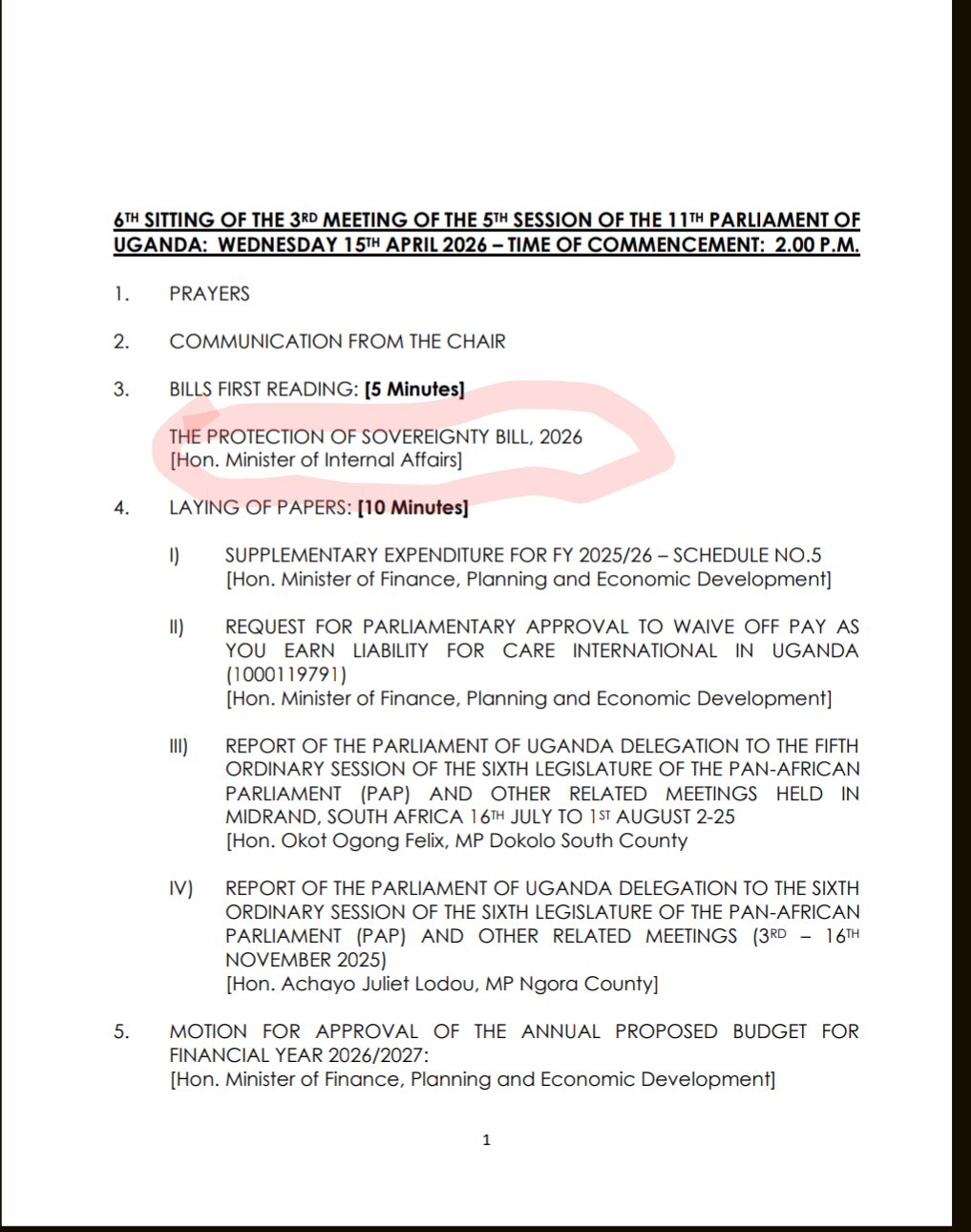
Kampala — April 14, 2026 The Government is expected to table the National Sovereignty Bill in Parliament tomorrow, with the Minister of Internal Affairs set to formally present the legislation for its first reading before lawmakers.
Once introduced, the Bill will immediately enter the parliamentary process, where it will be referred to relevant committees for detailed scrutiny, technical review, and further consideration before returning to the House for debate.
The proposed law is understood to have developed from earlier discussions around a separate NGO Funding Bill.
That earlier proposal reportedly focused on donor funding coordination, tax incentives for civil society organisations, and improving financial support structures for NGOs operating in Uganda.
However, during policy refinement, the funding and incentive components were removed and the remaining elements were consolidated into a broader National Sovereignty Bill.
The revised framework is now expected to focus on regulating foreign influence in governance and public policy spaces, as well as strengthening oversight of externally supported activities.
The shift represents a transition from a funding facilitation approach to a more regulatory and sovereignty-driven policy direction.
Ugandan businessman Nyanzi Martin Luther, commenting on the development, said he welcomes the expected tabling of the Bill, noting that while the original funding aspects were removed, the emphasis on reducing foreign dependency remains an important step in strengthening national self-reliance.
He added that clearer policy direction on external influence is necessary for long-term development planning.
Parliamentary sources say the tabling will mark the formal start of legislative scrutiny, with MPs expected to closely examine how the merged provisions will be implemented in practice, particularly in relation to foreign partnerships and donor-supported programmes.
The Bill is expected to attract significant attention once it reaches the floor of Parliament, given its potential implications for civil society organisations, development partners, and governance stakeholders operating in Uganda.